Why Does Sex Hurt After Having a Baby?
After birth, the tissue itself has changed. Scar tissue from tearing, an episiotomy or a cesarean, fascial restriction around it, and a pelvic floor that learned to guard are what meet pressure now. It’s tissue, not desire, not your relationship, and not permanent. Standard postpartum care rarely examines any of it.
In my work as a Certified Somatic Sex Educator and Sexological Bodyworker, I’ve sat with many women who were cleared at their six-week check and still couldn’t be touched six months later. Almost all of them had been told, by someone they trusted, that the problem was probably “in their head.”
Why does it still hurt when I was told everything healed?
First of all, new or worsening pain, bleeding, fever, foul-smelling discharge or any other sign of infection needs to be seen by your doctor or midwife before anything else. This article is about the pain that’s still there after that visit says you’re fine.
“Healed” in a postpartum check usually means closed. It doesn’t mean supple, well perfused, or able to glide and stretch under pressure. Those are different questions, and almost nobody is asking them – because almost nobody was trained to.
Dr. Ellen Heed, a pioneer in scar tissue remediation whose doctoral research is on women’s sexual pain after childbirth, names the gap bluntly. Clinicians, she says, are “unschooled about arousal, so they can’t possibly know, since they’re not trained to understand what healthy pelvic sexual function actually is, what scar tissue could do to inhibit that function.” She points out that there’s extensive research on abdominal adhesions, which can cause fatal bowel obstructions, and almost none on pelvic floor adhesions and sexual function.
She describes a client three months postpartum whose vulva was still bruised and pulled sideways by the tension her muscles held around a second-degree tear. Every professional the woman saw told her she was healed. Her body was reporting something else, accurately, the whole time.
What is scar tissue actually doing after a birth injury?
Most of us were taught that a scar is a finished thing. Ellen’s clinical position is the opposite:
“Scar tissue is dynamic. It doesn’t just sit there once you’re healed. The scar proliferates and continues to proliferate throughout the life of the body if inflammation is strong under the skin.”
That matters because of what a scar does to everything around it. In her words, “You can’t be healthy if your scars are unhealthy. If your scars are unhealthy, that means they are continuing to proliferate and continuing to shut down the plumbing of all the tissue around the scar, meaning blood delivery gets interrupted and lymphatic drainage gets interrupted.”
Every cell needs groceries in, which is blood delivery, and trash out, which is lymphatic drainage. Scar tissue can compromise both. And the vulva isn’t simple skin. It holds erectile tissue beds as extensive as the ones in a penis, entirely dependent on blood flow to fill, lubricate and respond. Restrict the plumbing and you don’t get a sore spot. You get a system that can’t come online.
None of the women in Ellen’s doctoral research had suspected scar tissue was involved in their pain. They’d been told it was psychological, relational or hormonal – “Relax more… Use more lubricant…”
Can sex hurt after birth even if I didn’t tear or have surgery?
Yes, and this surprises people. Scar tissue can form without a wound. Chronic muscular tension creates fascial restriction, fascial restriction creates adhesion, and adhesion creates pain. A pelvic floor that braced through the last weeks of pregnancy, through birth, then through months of lifting, feeding and sleeping badly has every reason to stay short.
Guarding is also intelligent. A body that met more sensation than it could metabolize meets the next approach already defended, faster than thought. That’s the same mechanism underneath numbness and lost sensation, which is why pain and numbness so often share a pelvis. Tissue that braces stops feeling. Some women notice it most at the cervix, which has its own reasons for going quiet.
Why does the pain seem to come from somewhere I wasn’t injured?
Because the pelvic floor refers. Pain shows up at a distance from the tissue producing it, which is one reason women get cleared by specialist after specialist.
Ellen gives an example that stayed with me… A client came to her with painful penetration, no history of abuse, no surgical scars, no obvious cause anywhere. What she did have was a hospitalization for constipation. Her anal sphincter had been chronically clenched for years, and the congestion that created referred pain forward into the vagina.
“The only reason it hurt when I pulled my finger out was because of that gripping,” Ellen says. “She was gripping her whole pelvic floor tight as a result of this psychogenic habit around elimination.”
Nothing was wrong where it hurt. Something was very much happening an inch away.
What actually changes postpartum scar tissue?
Ellen works with four contributors at once, because in her experience scar tissue answers to all four and rarely to just one.
Biomechanics. How you move, sit, lift and sleep. The tension patterns of daily life, which after a baby are considerable.
Biochemistry. Inflammation, food sensitivities, environmental load, hormonal shifts. This is what decides whether a scar keeps proliferating or settles.
Emotions. What the tissue was holding at the moment it was injured. Ellen has repeatedly found scar tissue softening under her hands as a woman lets herself remember what she’d been telling everyone, including herself, wasn’t that bad.
Meaning. The story you carry about what happened. Tissue contracts around “my body failed” in a way it doesn’t around “my body did something enormous and is still carrying it.”
The hands-on side is unglamorous. Organic castor oil is her staple, chosen because it increases lymphatic drainage and blood delivery and softens adhesions in connective tissue. An old pharmacologist she consulted told her simply, “Mucosal membranes love castor oil.” Then slow manual work across the fibers of a scar rather than along it. “Scar tissue can be remediated,” she says. “The notion of holistic remediation, not cutting out the scar, which just produces more scar tissue, this was a new idea.”
Underneath the technique, patience. “It takes a very neutral presence for the body’s story to unfold,” she says. “I’m holding the tissue without judgment, without trying to fix anything. People get so busy wanting to fix something, they never actually hear the problem.”
I won’t tell you how long any of this takes. Bodies don’t agree on that. What I can say is that this tissue is workable, which is a different and better sentence than “you’ll get used to it.”
A practice you can try
This is a listening practice, not a treatment. Skip it if you’re in the early weeks, if a scar isn’t fully closed, or if your provider hasn’t cleared you. Nothing here goes inside.
- Lie down somewhere private, knees bent, and let the floor take your weight for a few breaths.
- Place both hands over your pubic bone, heels of the hands resting on the front surface of the bone, palms draping softly.
- Curl your fingers underneath so they meet the bottom surface of the bone. Both surfaces at once. There’s something completing about holding your own pelvic bowl from two sides.
- Take ten slow breaths down into that space.
- Notice without correcting. Ache counts. Numbness counts. Nothing at all counts. You’re taking inventory, not fixing.
- Ask, silently: is there anything I need to hear from my pelvis right now? Then wait longer than feels natural.
If a scar is fully healed and you want to add tissue work, Ellen’s simplest tool is a small amount of organic castor oil worked gently across the line of an external scar rather than along it, every two or three days rather than daily, after testing a small patch first. Anything internal is worth doing with a trained practitioner.
Common questions
1. How long does sex hurt after having a baby?
There isn’t a standard timeline, and I’d be careful with anyone who offers you one. Some tissue settles within months. Some has been carrying restriction for years by the time anyone touches it. What predicts change is whether the tissue actually gets addressed, not how long it’s been.
2. Is painful sex after a cesarean normal, even though nothing was cut at the reproductive organs?
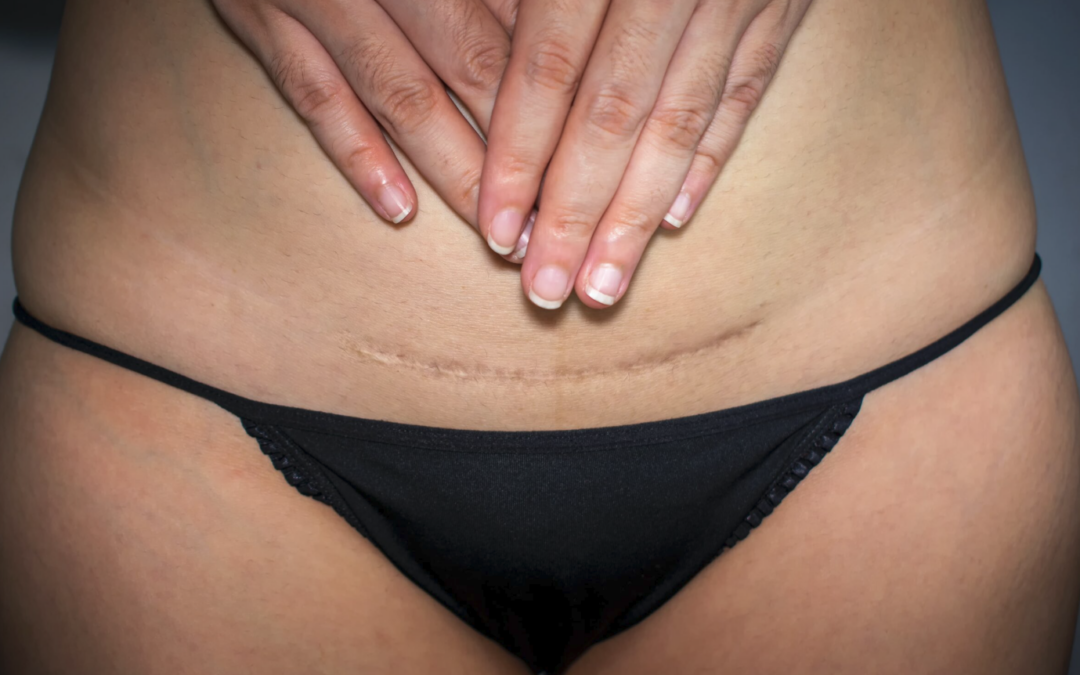
It’s common. A cesarean scar sits in layers of abdominal fascia that connect into the pelvis, and as Ellen describes it, adhesions restrict the tissue around them rather than staying politely in one place. Pain with penetration after abdominal surgery is a recognizable pattern, not a mystery.
3. Will more lubricant fix it?
Sometimes it helps, and it’s reasonable to try. But lubricant addresses friction at the surface, and scar tissue, fascial restriction and a guarding pelvic floor are underneath that. If lubricant hasn’t solved it, that isn’t a failure of effort. It’s information about where the problem actually lives.
4. Does painful sex after birth mean I’ve lost my desire for my partner?
Not by itself. A body that anticipates pain will down-regulate arousal, because that’s a sensible thing for a body to do. Desire often looks absent when it’s being suppressed by an accurate expectation of hurting. Change what the tissue does and desire usually has something to say.
5. My baby is five years old. Is it too late to do anything about the scar tissue?
No. Ellen’s whole position is that scar tissue stays dynamic for the life of the body, which is the bad news and also the good news. Tissue that can still change for the worse under inflammation can still change in the other direction with circulation, movement and skilled hands.
Closing
If you’ve been told everything looks fine and penetration still hurts, both can be true. The exam wasn’t wrong. It just wasn’t looking at scar tissue, fascia and muscle tone, and after a birth that’s usually where the pain is living. You didn’t imagine this, and you didn’t cause it by failing to relax. Your body has been telling the truth all along, and it deserves to be treated as an ally rather than a problem.
If you want a place to begin, the Genital Awakening Meditation is free, and comes with a 12-point genital armor checklist so you can see what your own body is carrying.
And if you want to rebuild capacity for arousal, intimacy and pleasure in a body that’s been through birth, Reclaiming Your Pleasure is where that work goes deeper.
Rahi Chun is a Certified Somatic Sex Educator and Sexological Bodyworker, creator of Somatic Sexual Wholeness, and host of the podcast “Your Body Remembers Pleasure.” Dr. Ellen Heed is a pioneer in scar tissue remediation whose doctoral research on women’s sexual pain after childbirth is available at EllenHeed.com.