Can You Heal Sexual Abuse You Don’t Remember?
Yes. The psyche often withholds memories until there’s enough support to hold them, in many cases, for decades. And healing doesn’t require the memory first. The body holds what happened, and somatic work can release it whether or not the mind ever supplies the story. As a Certified Somatic Sex Educator and Sexological Bodyworker, I’ve watched this unfold many times.
If you suspect something happened to you but have no clear memory of it, you’re not imagining things and you’re not stuck. The absence of memory isn’t a barrier to healing. Your body has been keeping the record, and it knows how to let it go when the conditions are safe and right for you.
Pamelah didn’t have memories of being sexually abused until she was forty years old. This is more common than most people realize, especially when abuse occurred very young and stopped early. The psyche, in its wisdom, often won’t allow memories to surface until there’s a sufficient support system in place to hold them. “I had all these little hints,” Pamelah says, “but until I knew I was in a safe enough place, until I had a therapist I trusted, someone I had worked with for years, I couldn’t be in the memory.”
Her body knew. Her nervous system knew. Her psyche waited until the conditions for healing were present.
Why do memories surface decades later?
Because the psyche is protecting you until you can survive the knowing.
The memories came for Pamelah during breathwork with a therapist she trusted deeply, a woman she describes as earthy and caring, someone she knew had her back. She’d gone in saying, “I think I’ve been sexually abused.” Her therapist knew what might be coming, and had the tools to help her stay present with it.
What surfaced wasn’t a mental image. It was visceral. “It felt real to me because I felt it,” she says. “It wasn’t a mental experience that I thought I was making up. I could feel it in my body.”
And then something extraordinary happened as she shared it. “I felt this experience of the cells in my body literally rearranging themselves. I could feel them moving. This space that I had been holding this secret, which is what it was, I was holding this secret, was now free.”
This is what happens when what’s been held in shadow is finally brought into light and received in safe space. The cellular structure can release the tension that went toward keeping the secret in the dark. The body can finally exhale.
Why do I leave my body during sex?
Because when a child is sexually abused, especially very young, the emotional body detaches and leaves. It’s a survival mechanism, the only way a small nervous system can cope with something far too overwhelming to integrate.
Pamelah recognized this pattern in herself long before she understood its origin. “I had an experience of being aware that when I would have sex as an adult, I would leave emotionally. I just wouldn’t be present.”
Once the memory returned, a floodgate opened. Patterns from her teenage years and young adulthood suddenly made sense. Why she flirted with older men. Why she couldn’t sustain long-term relationships. Why she left emotionally during sex. “I thought there was something wrong with me,” she says. “What’s wrong with me that I can’t stay in a long-term relationship?”
Nothing was wrong with her. A very young nervous system had learned to leave, and it kept doing what it learned.
What does healing actually require?
Safety, support, permission, and time. Not force, and not a schedule.
“The body’s sense of readiness is everything,” Pamelah emphasizes. “My psyche knew I couldn’t handle those memories until I had the support system in place. And even when the memories came, it took two years of therapy to work through all the consciousness changes that had to happen.”
Her path included several elements, and they mattered in combination: therapy with a practitioner who specialized in sexual abuse; a women’s group where she could hear other women’s stories and rebuild trust in female relationships; voice lessons with a teacher who held space for full emotional expression; tantra retreats where she learned inner pelvic release; and eventually somatic sessions where we worked to release the last layers of numbness and pain.
This isn’t a one-time event. Sexual healing from childhood trauma is a journey of integration. It requires recognizing the effects, making sense of behaviors that once seemed confusing, and gently inviting the body back into the present.
Why does permission matter so much?
Because a body that knows it has full authority can finally relax.
“One of the most significant things in our sessions,” Pamelah reflects, “was having permission to move at my pace. If something hurt, I could stop and acknowledge that it hurt instead of just tolerating it.”
This is foundational to somatic work: putting the body in the driver’s seat. When the body knows it can say stop, slow down, more, less, and that its word will be honored instantly, the nervous system can trust. And trust is the precondition for everything else.
She describes the pivotal moments. “I remember the day when my vagina, when you had your fingers inside and I felt pain, and I realized I had been numb all this time. I had no idea it was numb because I couldn’t feel anything.” This is the paradox of numbness: we don’t know what we can’t feel.
“And there was a day when entering my vagina didn’t hurt anymore. For a long time it hurt. And then one day it didn’t.”
She also worked with confusion, a sensation she first thought was happening in the moment, which turned out to be unintegrated emotion from past sexual experiences. “After I was present with that confusion, and we did some breathing and gave it a voice, it evolved into arousal and pleasure.”
What does the voice have to do with the pelvis?
More than most people realize. The throat nerve correlates with the pelvic nerve. The jaw muscles correlate with the psoas. Both are major orifices of the body, and they tend to open and close together.
Pamelah’s voice teacher understood that the more connected we are to our true emotions, the better we sing. So the assignments were unusual. “Your job today is to feel jealousy. Just sit for an hour and feel jealousy.”
“I sat there and I got really conscious of how I felt jealous. I felt the jealousy in my body. I had full permission to feel it. And after about an hour, I had gotten over the jealousy because I had permission to fully feel it.”
After her cat died, the assignment was to spend the weekend crying. “I spent a weekend just sobbing. And then I’d sing and my voice would sound better. Then I’d cry some more and my voice would sound better.”
This is the power of full permission to feel. When we stop holding emotions down, the body softens, the voice opens, and the pelvis releases.
A practice: hand on your heart
If you’re carrying unprocessed experiences, this simple practice helps resource your nervous system and build safety from the inside.
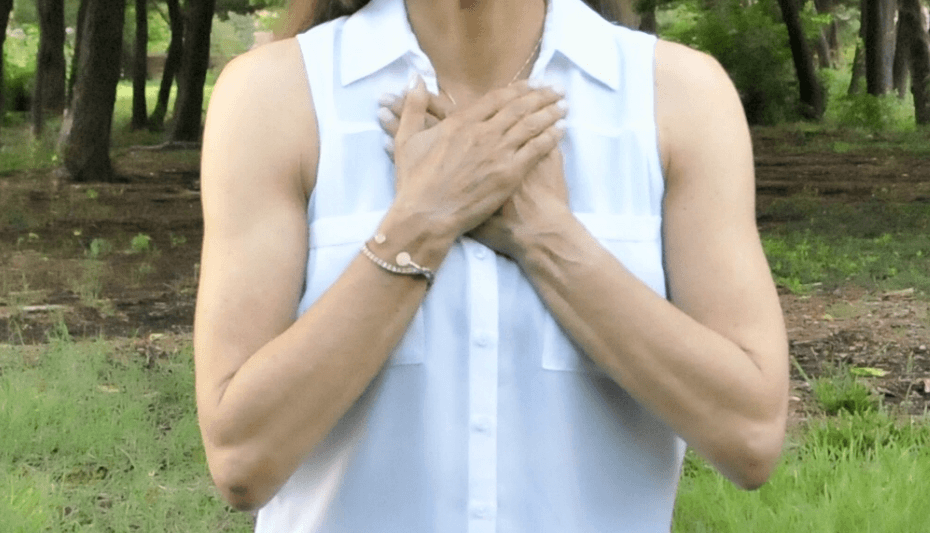
Find a quiet space where you won’t be disturbed. Sit or lie comfortably. Place one hand on your heart and the other, if it feels right, cupping your belly or pelvis.
Breathe slowly. With each inhale, imagine breathing from your heart down into your pelvis. With each exhale, imagine the breath rising from your pelvis back to your heart.
As you breathe, say silently to yourself: I am safe right now. My body is wise. I trust my pace.
Five to ten minutes, or as long as feels nourishing. Notice what sensations arise. Notice what emotions arise. Let them be present without needing to change anything. Re-visit this practice when your body feels curious about re-connecting with itself. There is a cumulative effect in self-awareness, self-trust, and self-compassion and care that the body begins to trust again.
Common questions
1. Can you heal from abuse you don’t remember?
Yes. Somatic approaches work directly with what the body holds, which doesn’t require narrative memory. Many people release significant held material without ever recovering a clear story, and the healing is no less real.
2. Are recovered memories reliable?
This is contested territory, and it deserves care. What’s clear is that bodily sensation and pattern can be genuine information even when the narrative is incomplete. Working with a skilled, non-leading therapist matters enormously, precisely because suggestion can shape memory.
3. Why did my memories surface now?
Often because your system finally has the support to hold them. The psyche tends to withhold what it doesn’t yet have resources to survive. Memories arriving can be a sign of increased capacity rather than a crisis, whether that involves greater emotional security in close relationships, therapeutic support, financial security leading to spaciousness beyond survival, and/or self-agency in greater somatic awareness and embodiment.
4. Why do I dissociate during sex?
Because dissociation was likely an effective survival strategy at some point. A young nervous system that couldn’t escape learned to leave internally. That pattern persists until the body has enough new experience of safety to stop using it.
5. How long does this take?
Pamelah’s process spanned years, not weeks, and included multiple modalities. That’s typical rather than slow. The body integrates on its own timeline, and pushing it usually adds guarding rather than progress.
Your body has been keeping a record it never asked to keep. The numbness, the leaving, the patterns that made no sense, these aren’t failures. They’re survival strategies that worked when you needed them. And when you’re ready, with support and safety and permission and time, they can be released.
If something here landed, the Genital Awakening Meditation is a gentle place to begin, about 15 minutes with nothing required of you but attention. It comes with a checklist of the twelve places armoring most often lives: rahichun.com/gift..
And if you’re on the path of restoring sensation and pleasure after trauma, Reclaiming Your Pleasure is where I walk that journey with you: rahichun.com/courses.
With reverence, Rahi
Pamelah Landers is a hand analyst and relationship coach, and a longtime friend and colleague. She shared her story with permission.
Rahi Chun is a Certified Somatic Sex Educator and Sexological Bodyworker specializing in genital de-armoring. More at RahiChun.com.