
BLOG ARTICLE:
What Is Karsai Massage?
with Tassanee “Coocky” Boonsom
In this article we explore Karsai massage, the traditional Thai and Taoist practice of restoring blood and energy flow to the pelvis, drawing on Rahi’s conversation with Chiang Mai teacher Tassanee “Coocky” Boonsom.
What Is Karsai Massage?
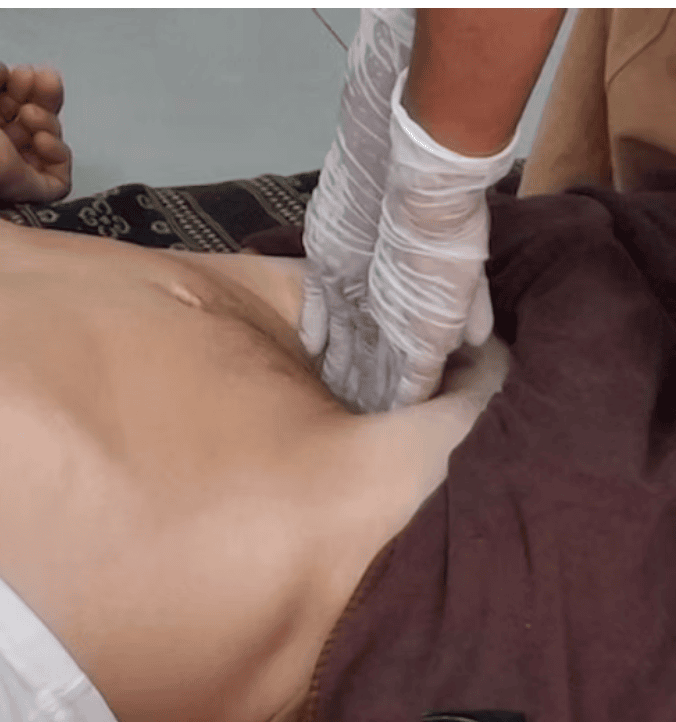
Karsai massage is a traditional Thai and Taoist bodywork practice that restores healthy blood and energy flow to the pelvis and genitals. It works through the abdomen, the inner thighs and the genital tissues to soften knots and congestion that can quietly dull desire, sensation, erection, lubrication and pelvic comfort. It’s therapeutic and educational, not sexual.
I first received and studied this work in northern Thailand, and it changed how I understand the pelvis. In my work as a Certified Somatic Sex Educator and Sexological Bodyworker specializing in genital de-armoring, I’ve come to see Karsai as one of the oldest living expressions of the same truth: the genitals are part of a whole body, and they thrive when life is allowed to flow to them.
Where does Karsai massage come from?
Karsai lives inside the Thai healing arts, where it’s often called Nuad Karsai, and in the Taoist lineage, where it’s known as Karsai Nei Tsang, the genital counterpart to Chi Nei Tsang abdominal massage. Much of it was passed from teacher to student by hand and by word rather than in books, and you’ll see the name spelled many ways: Karsai, Kasai, Karasai.
Traditional Thai massage maps the body through ten primary energy lines called sen, which radiate from the navel. One of my teachers, Tassanee “Coocky” Boonsom, founder of Loi Kroh Traditional Thai Massage school in Chiang Mai, sought out Karsai because the sen line running from the navel down to the pubic bone, called sen line 10, is often left untouched in modern Thai massage. That line is the main road for blood and energy into the genitals and the whole pelvic bowl.
What does the word Karsai mean?
In the way Coocky teaches it, Karsai refers to sedimentation: crystal-like deposits that build up in the vessels and tissues and show up under the hands as small knots, lumps or tangles. When they gather in the pelvis, the tradition holds, they restrict circulation and the natural movement of the organs.
What causes them? Food and environmental toxins play a part. But when I asked Coocky about emotional stress, she pointed straight at it. The body contracts around unexpressed fear, grief and anger, and over years that contraction can harden into the very congestion Karsai works to release.
How does a Karsai massage session work?
A session doesn’t begin at the genitals. It begins by opening space for circulation everywhere around them:
- The abdomen first. Abdominal detox massage (Chi Nei Tsang) opens the organs and the “wind gates” around the navel so there’s somewhere for congestion to move.
- Then the legs. The practitioner works the inner thighs and the points along the femoral artery, building a fresh reservoir of blood below the pelvis.
- Then the pelvis and genitals. Only with both reservoirs open does the practitioner work the genital tissues directly, sensing for knots and tangles and releasing them slowly.
Coocky also works deeply with the psoas, the large muscle linking spine and legs that Tibetan healers call the muscle of the soul. She finds it often holds old grief. Clients sometimes release sorrow they’ve carried for years, like the loss of someone they loved, without realizing it was still there.
This is also why grounding matters so much for the practitioner. Coocky teaches staying present in the client’s field without merging with their story, and drawing on universal life force rather than one’s own energy.
What is Karsai massage used for?
People come to Karsai massage for many reasons, and curiosity is one of the most common. Others come to maintain vitality as they age, or to prepare their bodies for conception. In Coocky’s experience:
- Men often seek it for low libido, erection or ejaculation concerns, scar tissue that pulls during arousal, or difficulty urinating that may relate to an enlarged prostate.
- Women often seek it for low lubrication, reduced engorgement of the labia and clitoris, painful sex, fertility preparation, a uterus or bladder that has shifted, and difficulty holding urine.
In Thai medicine, the body is made of four elements: earth, water, wind and fire. As Coocky put it, “for the sexual energy we call it fire.” When desire is gone, Thai speakers say there’s no fire. Karsai tends that fire by restoring flow.
I felt the difference myself in training. Working with a fellow student over just two days, I could feel how much more fully the blood was moving into his pelvis once the pathways from the torso and legs were cleared.
Karsai is not a substitute for medical care. Pain, bleeding, a change in urination or any new symptom deserves a doctor’s assessment first, and many people find Karsai a supportive companion to that care.
How is Karsai massage different from genital de-armoring?
They’re close cousins. Karsai focuses on circulation, congestion and the organs, working from the abdomen inward. Genital de-armoring focuses on the protective holding patterns the genitals form in response to overwhelm or broken consent: the numbness, pain or shutdown that often stays even when circulation is fine. In my sessions I draw on both, because the body rarely separates them. You can read more about armoring in Why Can’t I Feel Anything During Sex?, and about the male pelvis in What Does Prostate Massage Actually Do?
A gentle Karsai practice you can begin at home
Coocky’s first recommendation is the simplest: the root lock. Gently contract and release the pelvic floor, sitting or standing, many times a day. It keeps blood moving and the pelvic floor responsive.
You can also explore sen line 10 yourself:
- Lie on your back and imagine a line from just below your navel down to the center of your pubic bone.
- With one or two fingers, press gently but deeply into a point along that line, such as the dantian about an inch and a half below the navel, or the soft dip just above the pubic bone.
- Hold for one to two minutes, then release. Many people feel a pulse, then a warm wave of flow toward the pelvis.
- Notice what you feel, however subtle, without needing it to be anything.
This can be done before sleep, on waking, or during self-pleasure, to discover how flow and arousal speak to each other.
Common questions
1. Is Karsai massage sexual?
No. Karsai massage is a therapeutic practice focused on circulation, organ health and releasing congestion in the pelvis. Arousal can arise because these tissues are alive, and a skilled practitioner treats it as information, not as the goal. Agreements about touch and consent should be clear before any session begins.
2. What is the difference between Karsai and Chi Nei Tsang?
Chi Nei Tsang is Taoist abdominal massage that works with the internal organs. Karsai, or Karsai Nei Tsang, extends that work into the pelvis and genitals. A Karsai session almost always begins with abdominal work, because the belly has to open before circulation can return to the pelvis.
3. Can Karsai massage help with erectile dysfunction?
Many men seek Karsai for erection concerns, and restoring blood flow to the pelvis can support healthier arousal. Erectile changes can also signal cardiovascular or hormonal issues, so it’s wise to see a doctor first. Karsai works well alongside medical care and somatic work on performance pressure.
4. Is Karsai massage only for men?
No. Karsai is practiced for all bodies. Women seek it for low lubrication, reduced engorgement, painful sex, fertility preparation and pelvic organ support. The techniques differ by anatomy, but the principle is the same: clearing the way for healthy blood and energy flow.
5. How can I try Karsai massage on my own?
Begin with the root lock, gently contracting and releasing the pelvic floor through the day. Then explore sen line 10 by pressing and holding points between your navel and pubic bone for one to two minutes each. Go slowly and stop if anything hurts.
Where to go from here
The full conversation with Coocky, including her stories of sensing a client’s memories through her hands, is in the podcast episode Karsai, Libido and Genital Health for Men. You can learn more about her school at Loi Kroh Traditional Thai Massage.
If something here landed, the Genital Awakening Meditation is a gentle place to begin, about fifteen minutes with nothing required of you but attention. It comes with a checklist of the twelve places armoring most often lives: rahichun.com/gift.
And if you’re ready to learn how the genitals hold tension and how sensation returns, The 3 Keys to Genital De-armoring is where I teach this work fully: The 3 Keys to Genital De-armoring.
In reverence,
Rahi

ABOUT THE AUTHOR
Rahi Chun
Rahi is fascinated by the intersection of sexuality, psychology, spirituality and their authentic embodiment. Based in Los Angeles, he is an avid traveler and loves exploring cultures, practices of embodiment, and healing modalities around the world.
MORE ON THE PODCAST

Your Body Remembers Pleasure
BROWSE LATEST ARTICLES
GET YOUR FREE DOWNLOAD:
GENITAL BREATHING MEDITATION
Go Deeper Into This Work

If you’re ready to go to the root of genital numbness, pain, or disconnection, Rahi’s The 3 Keys to Genital De-Armoring guides you through the principles and hands-on practices of this work.
Learn the foundational principles and somatic practices to restore sensitivity, circulation, and pleasure in the genitals.